





Technomancy, Chaos Magic, and the Ancient Heresy Underneath It
My testimony — why I recognize this vocabulary: https://substack.com/@hopegirlblog/note/p-216623470?utm_source=notes-share-action&r=x5hw
Before we get into the history, I want to tell you where I’m coming from, because it matters for everything that follows. I became a Christian in 2016. Before that, I practiced forms of Wicca, or what I thought was being a “good witch,” and I was heavily caught up in New Age doctrine. When I found Jesus, I completely walked away from all of it. I shared that story once before, and I’ve reposted it — free, linked above.
I’m not telling you this to shock you, and I’m not here to mock anyone who’s where I used to be. I’m telling you because that background is why I can recognize this vocabulary when I see it: the words, the symbols, the way the ideas get framed. I hope it helps you recognize it too, and test it against Scripture.
This article is an educational overview of published sources and practitioners’ own descriptions of their own practice. It isn’t an endorsement, and I’m not making claims about any individual.
What Is Technomancy?
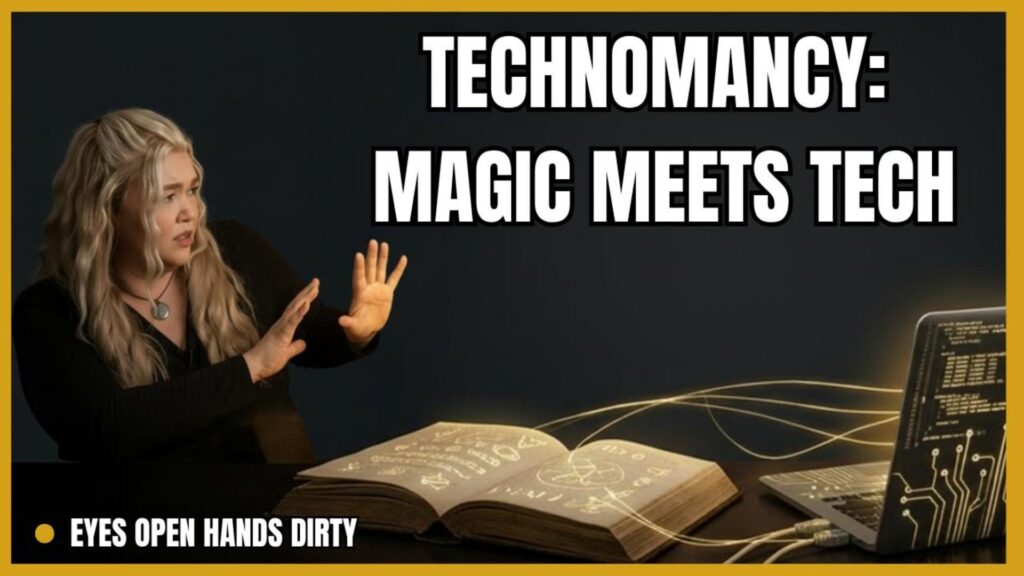
According to the community of practitioners who actually use the term, technomancy is, in their words, “the magickal study, practice, or phenomena of mystical occurrences” involving advanced technology (Magick Be). In plain English: it’s magic done through modern technology — anything from keeping a digital Book of Shadows to writing a piece of code designed to activate a spell.
The word itself breaks down neatly: the Greek techne, meaning art, skill, or craft, combined with -mancy, meaning divination or magical practice. Literally, “magic through craft or technology.” Technology is new, so you won’t find the word in any ancient grimoire — it’s being invented in real time as each wave of tech arrives. But the impulse behind it isn’t new. People have always combined magical thinking with the technology of their day.
There’s a documented example that predates the smartphone era by decades. A Minneapolis psychic-arts group called Psinergy Networks ran an educational website from 1993 to 2009, under the tagline “The Practical Use of Psychic Energy.” Archived copies of the site are still available. One page listed what the group called “Gift Senses” — psychic abilities with short definitions. Alongside telepathy and clairvoyance was technomancy, defined there as the ability to get technology to work without necessarily knowing how to operate it (Psinergy Education — Gift Senses List, archived). So the word was already circulating in a psychic-arts curriculum well before it showed up anywhere near a smartphone.
The full outline of that archived curriculum — with sourcing and capture dates for anyone who wants to check it themselves:

Austin Osman Spare and the Birth of Sigil Magic
To understand where modern technomancy comes from, you have to go back to a man most people have never heard of: Austin Osman Spare (1886–1956), equal parts brilliant artist and radical occultist. While the occult world around him was dressing up in robes and performing elaborate ceremonies inside hierarchical organizations like the Golden Dawn, Spare rejected all of it. His idea was elegantly simple: go straight to the subconscious mind. No intermediaries, no long rituals, no invoking external entities — just direct access to the part of the mind where, in his framework, real power lives. You can read more about his approach at the Hermetic Library.
Out of that came sigil magic, one of the most influential magical techniques of the modern era: a symbol encoded with intent, designed to slip past the conscious mind and plant itself in the subconscious. Spare also built his own personal “sacred alphabet.” What he built, in essence, was a system for hacking your own mind through symbols — and that idea didn’t stay in occultism for long.
Chaos Magic Arrives — 1970s England
The tradition now called chaos magic formally emerged in 1978 in England, driven by two figures: Peter J. Carroll and Ray Sherwin. Carroll’s Liber Null (1978) and Sherwin’s The Book of Results (1978) codified the early system, and the Illuminates of Thanateros (IOT), founded the same year, became the central practitioner network. Through the ‘80s and ‘90s the tradition spread through industrial music culture via Thee Temple ov Psychick Youth (TOPY), eventually bleeding into comic book pop culture (Chaos Magick Forge — History of Chaos Magick).
Chaos magic’s foundational idea is simple to state and enormous in implication: belief is a tool, not a truth. Where ceremonial magic says “follow these specific rules, in this specific order,” chaos magic says “use whatever works.” Results over tradition, pragmatism over dogma (Chaos Magick Forge — What Is Chaos Magick?). It’s sometimes called “postmodern magic” for a reason: just as postmodernism questioned whether any grand narrative was truly authoritative, chaos magic questioned whether any single magical system was truly correct. Its answer was no — all systems are tools, none of them Truth.
The practical implication is paradigm shifting: consciously adopting a belief system, working within it genuinely, then discarding it when it stops being useful. A practitioner might work with Christian language on Monday and something else entirely by Friday, because nothing is ever treated as absolute. Carroll introduced the term “meta-paradigm” for the framework above all frameworks: believe what’s useful, discard what isn’t, never confuse the map for the territory.
One of the least understood pieces of this system is what practitioners call paradigmal piracy — using the effective, credible-sounding elements of another belief system (a religion, a philosophy, a body of research) for magical or persuasive ends, without ever permanently adopting it. According to The Magical Buffet, a practitioner doing this can be genuinely indistinguishable from a sincere member of that tradition, because they engage with it fully while they’re using it.
The Hypersigil, and Moving Onto the Internet
In the late 1990s, comic book author Grant Morrison introduced the concept of the hypersigil: a magical working embedded inside a long-form narrative — a story, a comic series — designed to operate as a large-scale sigil on the culture itself. Morrison used his own series, The Invisibles, exactly this way. It marked a shift from chaos magic operating in underground lodges to chaos magic operating through mass media.
When the internet arrived, chaos magic migrated straight into it. Technomancy and technoshamanism became the dominant forms of the practice for this era — what Chaos Magick Forge documents as the tradition’s “third wave,” moving from physical lodges to cybernetic networks. As Technomancy 101 puts it, technomancers surged with the arrival of smartphones, improvising as fast as the tools evolve.
Within that framework, digital infrastructure — servers, social platforms, email — is treated as a modern ritual chamber. The described methods include writing code as a form of incantation, sending “charged” messages or images, coordinated group workings on forums and livestreams, and “digital servitors” — automated, parameter-driven thought-forms, described in the same language as an “if this, then that” automation script.
Runes fit into this too. The historical runic alphabets — Elder Futhark, Younger Futhark, Anglo-Saxon Futhorc — were never purely decorative; carving or painting a rune was itself considered an act. Practitioners describe combining runes into a merged symbol called a bindrune, treated as a kind of digital “program.” The claim attached to this practice — that a symbol displayed passively during a broadcast is continuously “charged” by viewer attention — is worth pausing on. It’s a claim from inside a belief system. It hasn’t been demonstrated. I’m telling you it exists so you can recognize it if you meet it, not because I’m endorsing it.
Gnosticism: An Ancient Heresy That Never Left
Here’s something that might surprise you — the philosophical framework underneath a lot of this isn’t modern at all. It’s a second-century heresy the early church spent real effort refuting, and it keeps quietly reappearing.
Gnosticism comes from the Greek gnosis, “knowledge.” As documented by the World History Encyclopedia, Gnosticism was a cluster of religious and philosophical movements that flourished in the second and third centuries AD. What unified them wasn’t a single creed but a shared assumption: spirit is good, matter is evil, the physical world (including the human body) is a flawed creation, and salvation comes not through faith in a historical event but through secret knowledge available only to the spiritually enlightened.
The Church Fathers who wrote against it — Irenaeus of Lyons, who called Gnostic texts “full of blasphemy” (Against Heresies), along with Tertullian, Justin Martyr, Origen, and Eusebius — identified five recurring errors:
The body is evil, being made of matter, in contrast to a God who is wholly spirit and wholly good.
Salvation is escape from the body through special knowledge, not faith in Christ.
The God of the Old Testament, who made the physical world, was not the true God.
Jesus didn’t actually have a physical body — he only seemed to (Docetism, from the Greek doceo, “to seem”), directly denying the Incarnation.
Secret knowledge separates the enlightened from ordinary people, creating a spiritual elite.
When a theology concludes the body is spiritually irrelevant, history shows it tends to produce one of two opposite results: harsh asceticism, or its mirror image, libertinism — the idea that since the body doesn’t matter, nothing done with it carries spiritual weight. Central Baptist Theological Seminary documents this pattern among historical Gnostic sects. (Those accounts come largely from Gnosticism’s opponents, so they’re worth holding with some care — but the underlying logic is the point: a low view of the body produces real consequences.)
Reformed theologians like Herman Bavinck have argued Gnosticism isn’t a historical curiosity but a recurring theological impulse — a challenge that resurfaces in a new costume in every era. Place for Truth and Reasons to Believe trace the same structure showing up again and again.
What Scripture Actually Says in Response
Scripture’s answer to all of this is clear and consistent. On the goodness of creation, it opens with God declaring the material world “very good” — Genesis 1:31. On the body specifically, the apostle John wrote that every spirit which confesses Jesus Christ has come in the flesh is from God, and every spirit that doesn’t is not — 1 John 4:2–3, language many scholars connect directly to the early Gnostic debate over Docetism. The Incarnation — God becoming physically human — is the foundation of Christian theology. A system that treats the body as spiritually irrelevant is directly at odds with that.
Chaos magic’s core claim — belief is a tool, not a truth — stands in direct contrast to how Scripture approaches truth. In Acts 17:11, the Bereans are commended for examining the Scriptures daily to check whether what they were told was true. That’s evidence-first faith. And 1 John 4:1 says to test the spirits to see whether they’re from God — testing, not fearing.
A Word on Vocabulary, and Where Words Travel
One more thing, and I want to be precise here. You may see people today using the words “Psinergy” and “Psinergist.” Here’s exactly what I can document: the earlier Minneapolis group’s archived pages don’t use the word “Psinergist,” and they don’t define “Psinergy.” The earliest use of “Psinergist” I’ve found is in online videos from 2023, with a definition published by an online community in June 2024. I haven’t found who first coined the word, and I’m not claiming to know. If you know of an earlier source, I’d genuinely like to see it.
Words travel. A term from a 1990s psychic-arts curriculum can resurface years later in a different setting, with different vocabulary layered around it. That isn’t automatically dishonest, and it doesn’t tell you what any particular person actually believes. It’s a reason to do two things: trace where a word came from, and ask what a specific claim actually rests on. That’s the whole point of this article — the sourcing above is here so you can check it yourself, not so you have to take my word for it.
Where This Leaves Us
Notice the thread running through all of it: sigils built to slip past conscious evaluation, a scientific-sounding vocabulary, a symbol working quietly in the background, secret knowledge reserved for the initiated. Much of it works best when nobody examines it closely. Scripture asks for the opposite.
And notice what Genesis 1:31 says: the physical world — the body, the ground — is very good. I spend a lot of my time with my hands in the dirt, and I don’t think gardening or building or preserving food is spiritually second-rate. Those are ordinary ways of honoring a good creation.
The right response to any of this isn’t panic, and it isn’t mockery either. It’s the same discernment we’re asked to bring to everything: know what a claim actually says, check it against what’s true, and treat the people who hold these ideas — including people who are curious or searching — with the dignity Christ modeled.
As a thank-you for reading this far, my husband and I are giving away a free Harmonic Phone Shield — you just cover shipping:
This is our small business — my husband and I hand-make orgonite ourselves, using the best ingredients we can source, because it’s something we built for our own home first. We’re giving away a free Harmonic Phone Shield, you just cover shipping, plus a few other exclusive deals we only offer here:
https://www.ftwproject.com/free-harmonic-shield-exclusive-deal/
Eyes Open, Hands Dirty.
Sources
Chaos Magic & Technomancy
Chaos Magick Forge — What Is Chaos Magick?
Chaos Magick Forge — History of Chaos Magick
Technomancy 101 — What Is Technomancy?
Magick Be — What Is Technomancy?
Hermetic Library — Austin Osman Spare and His Theory of Sigils
Academia.edu — Chaos Magick and the Legitimacy of Innovation
The Magical Buffet — Paradigmal Piracy Defined
Peter J. Carroll, Liber Null (1978)
Ray Sherwin, The Book of Results (1978)
Grant Morrison, The Invisibles
Tree Carr, Technomancy (2026)
Psinergy Networks (archived)
Psinergy Education — Homepage (archived, 1993–2009)
Psinergy Education — Gift Senses List (archived)
Gnosticism & Theology
World History Encyclopedia — Gnosticism
New Advent — Irenaeus: Against Heresies
Place for Truth — Early Heresies: Gnosticism
Reasons to Believe — Heresies Never Die: Gnosticism
Central Baptist Theological Seminary — Gnosticism: A Christological Heresy
Herman Bavinck, on Gnosticism as recurring theological impulse (via Place for Truth, Reasons to Believe)
Scripture
Genesis 1:31 (NIV)
Acts 17:11 (NIV)
1 John 4:1 (NIV)
1 John 4:2–3 (NIV)