





EU’s flagship industrial-scale insect farming operation goes bust
Last month, French insect farming startup Ÿnsect entered judicial liquidation, marking the end of a company that raised over $600 million despite its ambitions to build insect-based protein at an industrial scale.
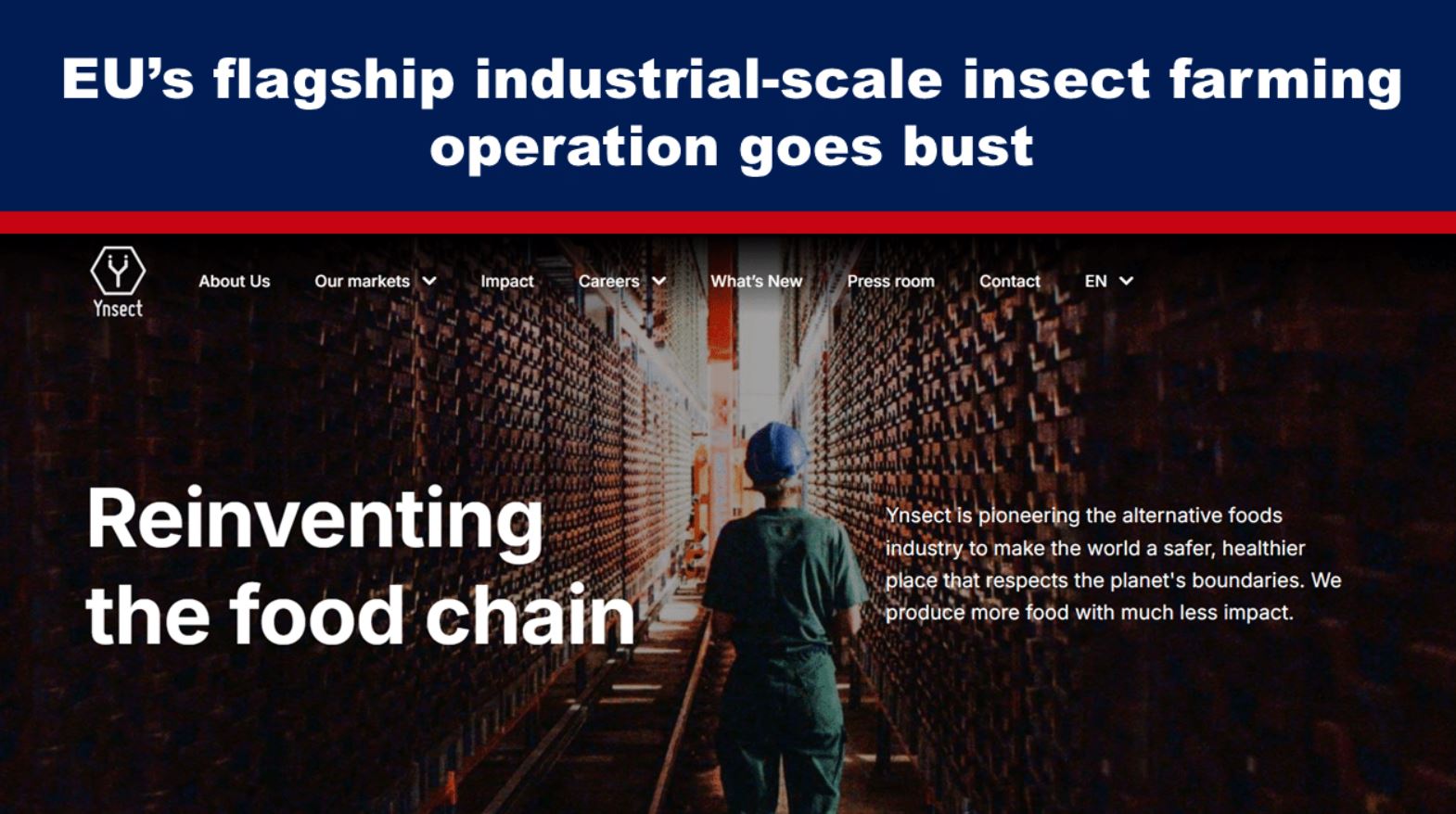
Last month, French insect farming startup Ÿnsect entered judicial liquidation, marking the end of a company that raised over $600 million despite its ambitions to build insect-based protein at an industrial scale.
The collapse follows years of financial struggles, including an inability to secure sufficient funding, persistent revenue shortfalls and high capital costs associated with its large-scale production facility, YnFarm.
The company, once highlighted by actor Robert Downey Jr. during the 2021 Super Bowl, failed to establish a viable economic model across its target markets of animal feed and pet food.
The trend towards insect-based foods is linked to the UN’s Agenda 2030 Sustainable Development Goals (“SDGs”), promoting sustainability and forced behavioural modifications. They claim the aim is to provide alternative sources of protein to humans and animals’ natural foods, such as beef.
However, as Dr. Meryl Nass pointed out some time ago, “Just because it is protein doesn’t mean it’s good for us.” And we would add, it’s not good for our pets and farm animals either.
Nass cited parasites that could be spread by insects, difficulties in digesting insects, and common allergies to chitin, commonly found on the exoskeleton of insects.
She suggested that one reason behind the shift to insects as food is “to cause emotional harm: to degrade, debase, downgrade human beings” and that beef is “being demonised,” potentially to “weaken the species.”
So it’s good news for humanity and our animals that Ÿnsect, a French insect farming pioneer that was at one time a flagship for Europe’s climate tech ambitions, has gone bust.
The following is an article published by Press Kit at the end of last month describing the demise of the EU’s flagship insect farming operation. It seems Ÿnsect was a non-starter rather than a start-up. Although it hasn’t dissuaded smaller insect farmers from forging ahead. Proponents of insect farming in the UK are viewing it as a problem with large-scale operations before the “technology” is ready and are sure that their “measured, evidence-led” approach will succeed where Ÿnsect has failed.
Read more: Ÿnsect’s collapse raises big questions: Is feed and fertiliser the future of insect farming? AgTech Navigator, 8 December 2025
French Court Declares Europe’s Largest Insect Farming Company Bankrupt
By Press Kit, 30 December 2025
Ÿnsect, Europe’s largest insect production company, was unable to secure the financing it needed to continue operating, despite massive past funding, and was liquidated, declared bankrupt, placed into judicial liquidation – essentially bankruptcy – due to insolvency, and closed down by the court in Évry, 35 km south of Paris.
And revenue was the problem. According to publicly available data, Ÿnsect’s revenue from its parent company peaked at €17,8 million in 2021 (about $21 million), a figure apparently inflated by internal transfers between subsidiaries. By 2023, the company had accumulated a net loss of €79,7 million ($94 million), Tech Crunch reports.
Now, following the court’s decision, the Poulainville factory farm will close permanently.
“The company now has solid technologies and an operating model, although the necessary financing was not secured in time,” says Emmanuel Pinto, President of Ÿnsect, despite the multimillion-dollar project receiving massive EU funding.
It had raised over $600 million, including funds from Downey Jr.’s FootPrint Coalition, taxpayers, and many others. The company also secured a €160 million ($175,5 million) Series D financing round in 2023 with the aim of developing its portfolio and accelerating marketing authorisations for its ingredients in several markets, Global Pet Industry reports.
Additionally, the company has received approximately €170 million in convertible bonds, €150 million in bank debt, and approximately €20 million in public subsidies, including €15 million from the European Union. In the same year, the French company also initiated a rebranding and transferred its ingredient-based product portfolio under the Sprÿng brand.
In 2020, the company announced a further capital increase of €315 million, primarily intended to finance the construction of a factory in Poulainville (Somme department). This facility is designed to become the largest vertical farm in the world.
Another capital increase of €160 million followed in April 2023. Local authorities and policymakers saw the project as a contribution to industrial development and ecological transformation.
The project has received further support from local authorities and policymakers.
It was launched and presented as a start-up symbolising the industrial boom in the insect industry, but within a few months, it turned into one of the most expensive industrial flops of the decade. “Iron Man” star Robert Downey Jr. extolled its merits on the “Late Show” during the 2021 Super Bowl weekend, The Epoch Times reports.
Ÿnsect had been struggling for months. The company’s vertical mealworm farm in Dole (55 km from Dijon), which produced 200.000 tons of insect-based ingredients annually, was sold in June, Global Pet Industry reports.
Ÿnsect instead focused on producing insect proteins for animal feed and pet food. In 2021, it expanded its operations and acquired Protifarm, a Dutch company that breeds mealworms for human consumption, adding a third market to the mix. Even when the company announced the deal, then-CEO Antoine Hubert admitted that it would take a couple of years before human food would only account for 10-15% of Ÿnsect’s revenue.
“His proposition was simple: offer an alternative to resource-intensive proteins like fishmeal and soy. This same thesis also attracted significant capital to competitors like Better Origin and Innovafeed, and it looked promising,” Tech Crunch continues.
But the vision collided with market reality. Animal feed is a commodity market driven by price, not sustainability premiums. In a perfect world, insect protein would be completely circular, with insects fed food waste that would otherwise end up in a landfill. But in practice, industrial-scale insect production typically ends up relying on grain byproducts already usable as feed, meaning insect protein simply adds a costly additional step. For animal feed, the calculations simply didn’t add up.
Ÿnsect eventually realised this. Pet food proved to be a different equation: it’s less price-sensitive than animal feed and represents a far better market for insect protein, despite competition from other protein alternatives like lab-grown meat. By 2023, the company had refocused its strategy on pet food and other higher-margin segments, with Hubert citing broader economic pressures.
Sources:
- How reality crushed Ÿnsect, the French startup that had raised over $600M for insect farming, Tech Crunch, 26 December 2025
- Europe’s largest insect farm closes: Million-dollar project fails despite EU money, Epoch Times (German to English translation), 23 December 2025
- French court orders liquidation of Ÿnsect: what happens now, Global Pet Industry, 4 December 2025
Source: https://expose-news.com/2026/01/09/eus-flagship-insect-farming-goes-bust/
Bitchute: https://www.bitchute.com/channel/YBM3rvf5ydDM/
Telegram: https://t.me/Hopegirl587
EMF Protection Products: www.ftwproject.com
QEG Clean Energy Academy: www.cleanenergyacademy.com