






Christians are Disappearing from the Middle East – And the West Is Doing Nothing About It
For nearly two millennia, Christianity has been woven into the fabric of the Middle East. Long before Europe adopted the religion, ancient churches flourished from Jerusalem to Damascus, Antioch, Mosul and Alexandria. Today, those communities are disappearing at an alarming pace, and not only is it going unreported, but it’s more impactful than most realise.
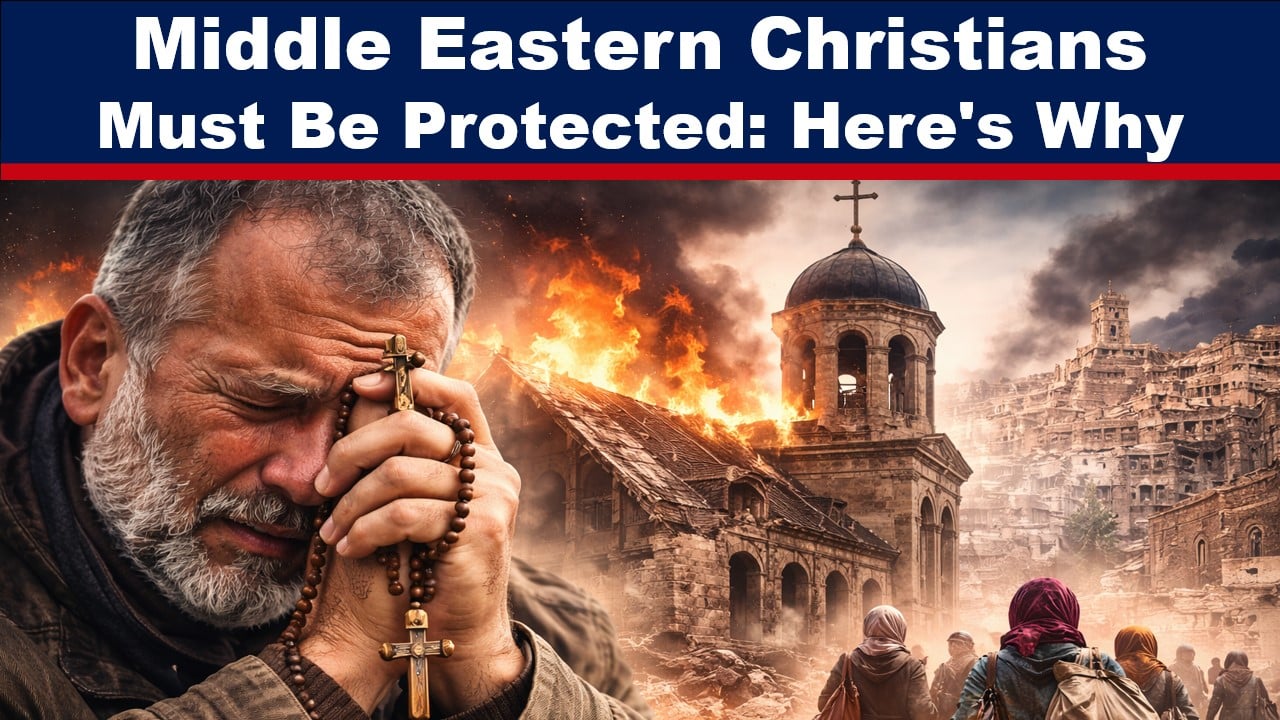
For nearly two millennia, Christianity has been woven into the fabric of the Middle East. Long before Europe adopted the religion, ancient churches flourished from Jerusalem to Damascus, Antioch, Mosul and Alexandria. Today, those communities are disappearing at an alarming pace, and not only is it going unreported, but it’s more impactful than most realise. In country after country, populations of Christians have collapsed catastrophically thanks to war, Islamist extremism, economic pressure, and quiet discrimination emptying lands where Christianity was once native. The result is the erasure of a moderating, pluralistic presence from one of the world’s most volatile regions. And, what’s even more concerning is the West’s seemingly total indifference to it.
A Civilisation Older than the West Itself
Christianity didn’t arrive in the Middle East – it was born there. The earliest communities spoke Aramaic and Greek rather than Latin and English, and cities such as Antioch – where believers were first called Christians – and Alexandria were cultural and theological centres centuries before Europe emerged from paganism.
These early churches survived Roman persecution, Islamic conquest, and Ottoman rule. But what they are struggling to survive today is totally different: the modern collapse of order, combined with ideological hostility and Western disengagement. When Christians leave an area, they rarely return, and the cultural loss is permanent.
The Brutal Numbers Most are Missing
The demographic collapse is stark. In Iraq, Christians made up 10% of the population as recently as one century ago. Today, they are well under 2%, numbering fewer than 300,000 in total. In Syria, the Christian population has fallen by more than half since 2011 – in the past 14 years alone. Lebanon was once a rare Christian-majority state in the region, but now sees its Christian share being eroded by emigration and demographic imbalance.
Even in Egypt, home to the ancient Coptic Church, Christians face persistent discrimination, second-class legal status, and sporadic violence. Across the Middle East and North Africa, the trend is consistent: fewer Christians with less protection and more pressure to leave.
At the start of WWI, Christians represented 20% of the region’s population. Today, it’s estimated to be less than 3%, with a decline from 3.3 to 2.9% being reported between 2010 and 2020 alone.
Why Christians Matter to the Region
Christian communities have historically played an outsized role in education, medicine, diplomacy, and commerce. They often functioned as cultural bridges between East and West, tradition and reform, or Islam and secular modernity. So, this is about more than just religious solidarity.
Their disappearance accelerates sectarian polarisation. As pluralism weakens, societies tend to harden into binary identities, such as Sunni vs Shia, Islamist vs authoritarian, and tribe vs tribe. Christians are not the sole victims of this process, but their exit removes a critical anchor of modern civic life.
Ultimately, a Middle East without Christians is not simply less Christian. It’s also more fragile, more extreme, and less tolerant.
So, Where are the Headlines?
Unlike other global causes, the persecution of Middle Eastern Christians rarely dominates Western media or international political agendas. Churches are bombed, villages are emptied, and communities are threatened – mostly without any proper coverage.
Part of the reason seems to be discomfort. If the West acknowledges the systematic targeting of Christians, then it complicates existing, “tidy” narratives on conflict, colonialism, and cultural relativism. It also raises uncomfortable questions about Islamist violence, minority rights, and the limits of Western foreign policy.
Silence in this case, however, is not neutrality. It should be taken as acquiescence. Is the West aware of the problem, but accepting of it?
The Complete Failure of Western Policy
Western governments routinely affirm their commitments to religious freedom and human rights, but in practice they have done remarkably little to slow or reverse the disappearance of Christians from the Middle East. The stark gap between rhetoric and action is a huge problem. While the US and EU produce annual reports dedicated to religious freedom, any mechanisms discussed rarely translate into binding conditions on aid, trade, or diplomatic engagement.
Following the defeat of ISIS in Iraq, Western funding focused overwhelmingly on general reconstruction, with limited targeted assistance to Christian towns such as Qaraqosh and Bartella that have been completely destroyed and emptied. Militias continue to intimidate returning Christians, and Western governments choose to defer to Baghdad rather than conditioning support on minority protection. The result is predictable: Christians are choosing permanent emigration over risky return to their homes.
In Syria, Western sanctions designed to punish the government also severely restrict reconstruction and economic recovery, which disproportionally affects minority communities. Christian leaders in the country have repeatedly warned that sanctions – which do make political sense – are accelerating emigration by making life unsustainable. In the West, this is often dismissed as collateral damage.
In Egypt, Western governments continue their military and economic cooperation missions despite persistent structural discrimination against Coptic Christians, including restrictions on church construction, uneven law enforcement following sectarian violence, and the routine use of “reconciliation sessions” that pressure Christian victims to drop legal claims. Aid and arm sales continue with few minority-rights conditions attached.
What the West is Not Doing
In effect, Western policy has treated the disappearance of Middle Eastern Christians as humanitarian afterthought rather than a strategic failure. The unspoken assumption seems to be that pluralism can be exported to the West, even if it collapses at the source.
The West has not established internationally monitored safe zones for vulnerable minorities, is not openly discussing minority protection in post-conflict statements, and has not imposed targeted sanctions on non-state actors who persecute Christians. Simply, it has largely accepted emigration as a reasonable substitute for survival, offering asylum instead of insisting on conditions that would allow ancient communities to remain in place.
Final Thought
The disappearance of Middle Eastern Christians is not inevitable. It’s the result of choices in the region – by local actors who persecute as well as international leaders who look away. The question is whether the West continues to treat this as a marginal issue, or recognise it as a civilisational and strategic concern.
Defending these communities does not mean imposing Western values. It means defending the basic rights of ancient peoples to remain where they have always lived. If Christianity vanishes from the Middle East, it will not be because history demanded it, but because the modern world decided it did not matter enough to stop it.
Bitchute: https://www.bitchute.com/channel/YBM3rvf5ydDM/
Telegram: https://t.me/Hopegirl587
EMF Protection Products: www.ftwproject.com
QEG Clean Energy Academy: www.cleanenergyacademy.com